
Google's Gemini Robotics 2 and the Death of the Chatbot Cop-Out

Our read
For years, Big Tech treated AI as a glorified office clerk that summarizes emails and drafts marketing copy. By embedding Gemini 2 directly into physical actuators, the era of safe, sterile chatbot containment is officially over, shifting the AI race from digital screen-saving to real-world physical agency.


What happened
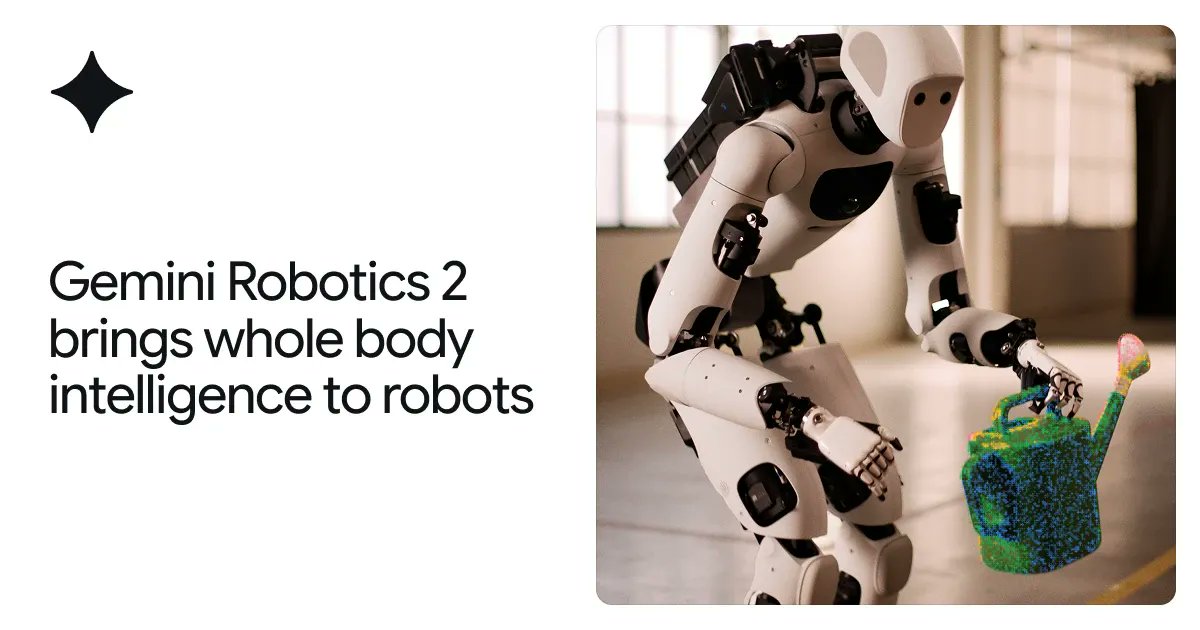
Google DeepMind released Gemini Robotics 2, introducing 'whole-body intelligence' that merges vision-language-action models directly with physical robot control.
The brief
This is the end of the line for purely digital AI hype; if your multi-billion-dollar model can't fold laundry or turn a wrench, it is rapidly becoming a legacy software tool.
The sides
- Software Purists
Generative AI should remain in the cloud as a safe, text-based assistant to avoid physical liability and real-world unpredictability.
- Hardware Realists
AI is useless if it cannot manipulate the physical world, and true intelligence requires embodiment and physical agency.
Why now
Google's sudden pivot to physical embodiment with Gemini Robotics 2 has triggered a massive wave of technical interest across developer forums. Engineers are realizing that the next phase of the AI war won't be won in a chat window, but in the messy, unsimulated physical world where code meets hardware.
Questions
What is Gemini Robotics 2 and how does it change the AI landscape?
Gemini Robotics 2 is a physical intelligence framework from Google DeepMind that merges vision-language-action models directly with physical robot control. Instead of confining AI to a sterile chat window to summarize emails, this update gives neural networks direct control over physical actuators. It shifts the AI race from digital screen-saving to real-world physical agency, turning the model into an active agent that manipulates the physical world.
Why is Google shifting focus from digital chatbots to physical robotics?
Google is pivoting because the digital chatbot market is saturated and offers diminishing returns on raw utility. Software-only AI has hit a wall of sterile containment where models merely shuffle text. By embedding Gemini 2 into physical hardware, Google aims to capture the massive, untapped industrial and domestic automation markets before agile hardware competitors lock them out.
Who stands to lose the most from the rise of physical AI models?
Legacy industrial robotics companies relying on rigid, hard-coded automation pipelines are the biggest losers. Companies like Fanuc or ABB have built empires on robots that perform exactly one repetitive task in a highly controlled environment. Gemini Robotics 2 introduces dynamic, adaptable physical intelligence that makes these expensive, single-purpose programming pipelines obsolete.
What is the strongest counter-argument to Google's physical AI push?
The physical world has zero tolerance for the hallucinations and edge-case failures that are common in large language models. While a chatbot hallucination merely results in a bad paragraph, a physical robot hallucination means destroyed inventory, broken hardware, or human injury. Critics argue that deep learning models lack the deterministic safety guarantees required for heavy physical labor.
How does Gemini Robotics 2 compare to Tesla's Optimus approach?
Google is building a generalized, hardware-agnostic intelligence layer, whereas Tesla is vertically integrating its AI directly into proprietary humanoid hardware. Tesla relies heavily on its custom Dojo supercomputers and end-to-end vision trained on driving data. Google is positioning Gemini 2 as the universal brain that any third-party robotics manufacturer can license and plug into their own machines.
What happens next now that AI has physical agency?
The immediate next step is a massive deployment of these models into controlled commercial environments like fulfillment warehouses and light manufacturing plants. We will see a rapid transition from pilot programs to full-scale physical automation within the next eighteen months. This shift will trigger intense regulatory battles over physical safety standards and labor displacement in blue-collar sectors.
Receipts
Related dispatches
- World Models, JEPA, and the Path to Sample-Efficient RLThe AI industry is slamming into a hard wall of its own making, trying to brute-force physical agency by scraping more internet text and paying humans to manually pilot robots. The frontier cannot scale on next-token prediction, it requires compact, mathematically rigorous world models that let machines simulate actions and anticipate failure without touching the physical world.
- Linus Sebastian Exposes ChatGPT's PC Build Guide as a Physical HazardChatGPT PC build advice will route your fan through your RAM if you trust it, and Linus proved that on a workbench.
- The Secret AI Arms Race We Knew Was ComingThe borderless open-source sermon is dead. You cannot preach global model harmony when the competitor is a state-subsidized machine designed to eat your lunch. Washington is finally treating code like a weapon, not a public library.
- The Physical AI Pivot: Why Atoms Are Eating Software's LunchThe next wave of generational technology wealth is shifting from digital screens to physical AI. Driven by a terminal demographic cliff in heavy labor, the industry's winning play is not building high-risk consumer robotaxis, but white-labeling software to make legacy industrial fleets autonomous.
- The Death of the Outbound LinkGoogle is unilaterally canceling the foundational trade of the open web, using AI Overviews to keep users on its own pages while forcing publishers into a toxic trap: let the machine clone your business for free, or vanish from search entirely.
- Amazon Cut AGI Research Because Sci-Fi Does Not CheckoutAmazon just told on the whole industry: AGI theater loses when the spreadsheet asks what ships to customers. White papers on machine consciousness do not ring registers. Retail AI that does, does.